9.1 Reading and Interpreting Audio Graphs
Frequency Response Graphs
The frequency response graph is the most important visual in audio. Everything else is secondary.
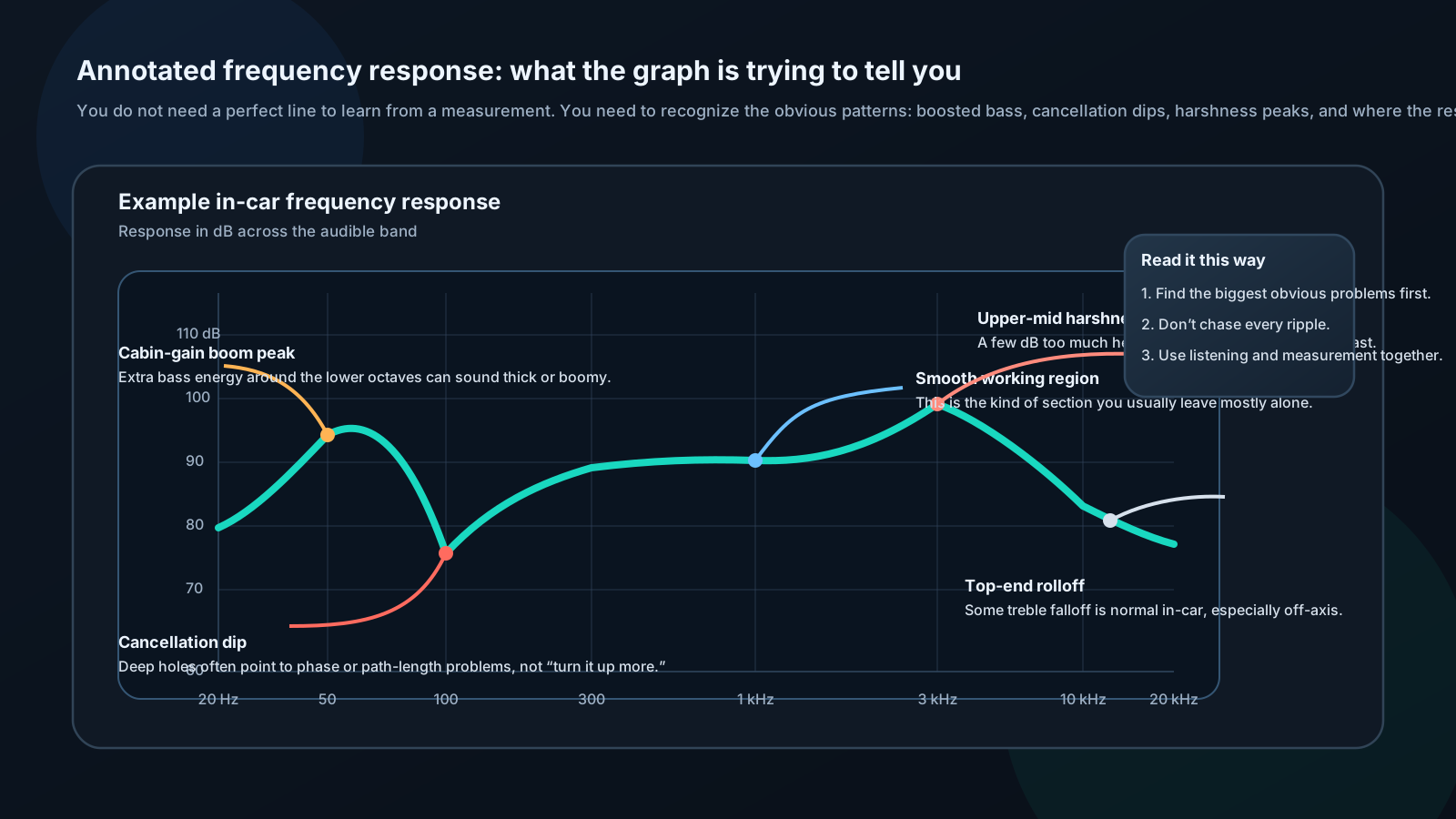
[VISUAL PLACEHOLDER: FrequencyResponseReading_Guide.png] Description: Annotated frequency response graph with: X-axis labels at 20 Hz, 100 Hz, 1 kHz, 10 kHz, 20 kHz; Y-axis labels at -20, -10, 0, +10, +20 dB; callouts pointing to a peak at 80 Hz labeled "cabin resonance +8 dB", a dip at 250 Hz labeled "crossover transition -6 dB", and a broad rolloff above 12 kHz labeled "tweeter natural rolloff"
X-axis (horizontal): Frequency
Always logarithmic — each decade (10× increase) takes the same horizontal space. This matches human hearing, which is logarithmic: we hear equal steps between octaves, not equal steps between Hz values.
Left edge = 20 Hz (lowest audible bass) Right edge = 20,000 Hz (highest audible treble) Middle of graph ≈ 1,000 Hz (midrange)
Y-axis (vertical): Level in dB
0 dB = reference (usually the average level of the curve) Positive dB = louder than reference Negative dB = quieter than reference
Scale matters: A graph with ±30 dB scale looks very different from the same data on a ±10 dB scale. Always check the scale before judging how flat or uneven a response looks.
[VISUAL PLACEHOLDER: SameResponseDifferent_Scales.png] Description: Same frequency response curve plotted on three different Y-axis scales: ±30 dB (looks flat), ±10 dB (looks moderate), ±5 dB (looks extreme) — illustrating why scale matters
Common features to identify:
| Feature | What it looks like | What it means |
|---|---|---|
| Peak | Sharp upward spike | Resonance — a frequency reproduced louder than neighbors |
| Dip | Sharp downward notch | Cancellation — two sources opposing at that frequency |
| Rolloff | Gradual slope downward | Natural limit of speaker or filter |
| Shelf | Step change, then flat again | EQ shelf filter applied |
| Ripple | Regular wavy pattern | Interference from reflections or comb filtering |
| Plateau | Flat region | Driver reproducing uniformly in that band |
Impedance Curves
[VISUAL PLACEHOLDER: ImpedanceCurveComplete_Guide.png] Description: Impedance vs frequency graph with labeled features: Fs peak (high impedance), minimum impedance region, inductive rise at high frequency; separate curves shown for sealed vs ported enclosure
Impedance peaks:
- Unenclosed or sealed: Single peak at Fs — the driver's free-air or box resonance
- Ported enclosure: Double peak, split around port tuning frequency Fb. The valley between the peaks occurs at Fb.
Reading Fs from impedance:
The frequency of the impedance peak in a sealed box = system resonance Fc. In free air = Fs.
Reading Fb from ported impedance:
The frequency at the valley between the two peaks = port tuning frequency Fb. This is a reliable way to confirm box tuning without acoustic measurement.
Minimum impedance:
The lowest point of the impedance curve (usually between resonance and mid-bass) is the true minimum load the amplifier sees. This is what matters for amplifier stability, not the nominal rating.
Inductive rise:
Impedance increases above a few kHz due to voice coil inductance. For a nominal 4Ω speaker, impedance at 10 kHz may be 10–20Ω. This affects power delivery at high frequencies and passive crossover design.
Waterfall / CSD Plots
[VISUAL PLACEHOLDER: WaterfallReadingGuide.png] Description: 3D CSD waterfall with annotations: time axis (0 to 500 ms), frequency axis (20 Hz to 5 kHz), level axis; arrows pointing to a resonance ridge at 95 Hz labeled "panel resonance — dampening needed" and a clean decay region labeled "good transient response"
How to read time axis:
Left face of waterfall = time zero (immediately after signal stops) Going back (depth) = increasing time after signal ends A frequency that appears only at time zero has decayed instantly — excellent. A frequency that extends far back has lingered — a resonance.
Practical threshold:
Any frequency taking more than 100–150 ms to decay 30 dB is problematic for most music. Bass frequencies (below 80 Hz) naturally take longer due to longer wavelengths — allow 200–300 ms there.
What ridges indicate:
- 40–120 Hz ridge: Vehicle panel resonance (doors, trunk floor, roof)
- 200–500 Hz ridge: Enclosure wall resonance or interior cavity
- 800–2000 Hz ridge: Dashboard or door trim resonance
- Above 2 kHz ridge: Much less common, usually thin metal panel
Phase Response Graphs
[VISUAL PLACEHOLDER: PhaseResponseInterpretation.png] Description: Phase vs frequency graph showing: gradual linear phase rotation (good), phase wrapping (normal at extremes), abrupt phase jump at a crossover (potential issue), smooth through-band behavior
Phase is displayed in degrees, wrapping between +180° and -180°. Don't be alarmed by wrapping — it's normal. The shape and rate of change matter more than the absolute value.
Smooth phase: Gradual, continuous rotation. Indicates minimum-phase system with no anomalies.
Abrupt phase jumps: Sudden 90–180° discontinuities at specific frequencies. Often indicates cancellation, a problem crossover setting, or driver reversal.
Phase at crossover: Expect 90° shift per crossover order. An LR4 (24 dB/octave) crossover produces 360° total shift — both drivers in same effective polarity at crossover.
Group Delay Graphs
[VISUAL PLACEHOLDER: GroupDelayExample.png] Description: Group delay (ms) vs frequency graph showing: peaked group delay at subwoofer resonance (~2 ms), flat group delay in midrange, slight rise at tweeter crossover; dashed line at 10 ms labeled "audibility threshold for most listeners"
Group delay is the time delay as a function of frequency. Constant group delay = no time distortion. Frequency-dependent group delay = different frequencies arrive at different times.
Audibility thresholds (from research):
- Below 500 Hz: Group delay up to 15–20 ms generally inaudible
- 500–2000 Hz: Audible above 5–10 ms
- Above 2000 Hz: Audible above 1.5–3 ms
Bass frequencies (below 100 Hz) tolerate much more group delay — the long wavelength prevents temporal resolution. High frequencies are most sensitive.
Causes of high group delay:
- Sharp (high-Q) low-frequency resonances
- Ported enclosure below tuning frequency
- Sharp digital crossover filters
- Room modes at bass frequencies