Installer Level: Port Design and Construction
A bigger port usually runs quieter, but it also has to be longer to hit the same tuning frequency.
Choose the port type, keep air speed under control, and make sure the required duct length still fits inside the box you can actually build.
This page covers practical sizing rules, a corrected worked example, and the tradeoff between port area, length, and box volume.
Port design is where a lot of good box ideas go bad. A port that is too small makes noise. A port that is too large may become too long to fit. The job is to balance air speed, tuning frequency, and buildable geometry.
Round vs. Slot Ports
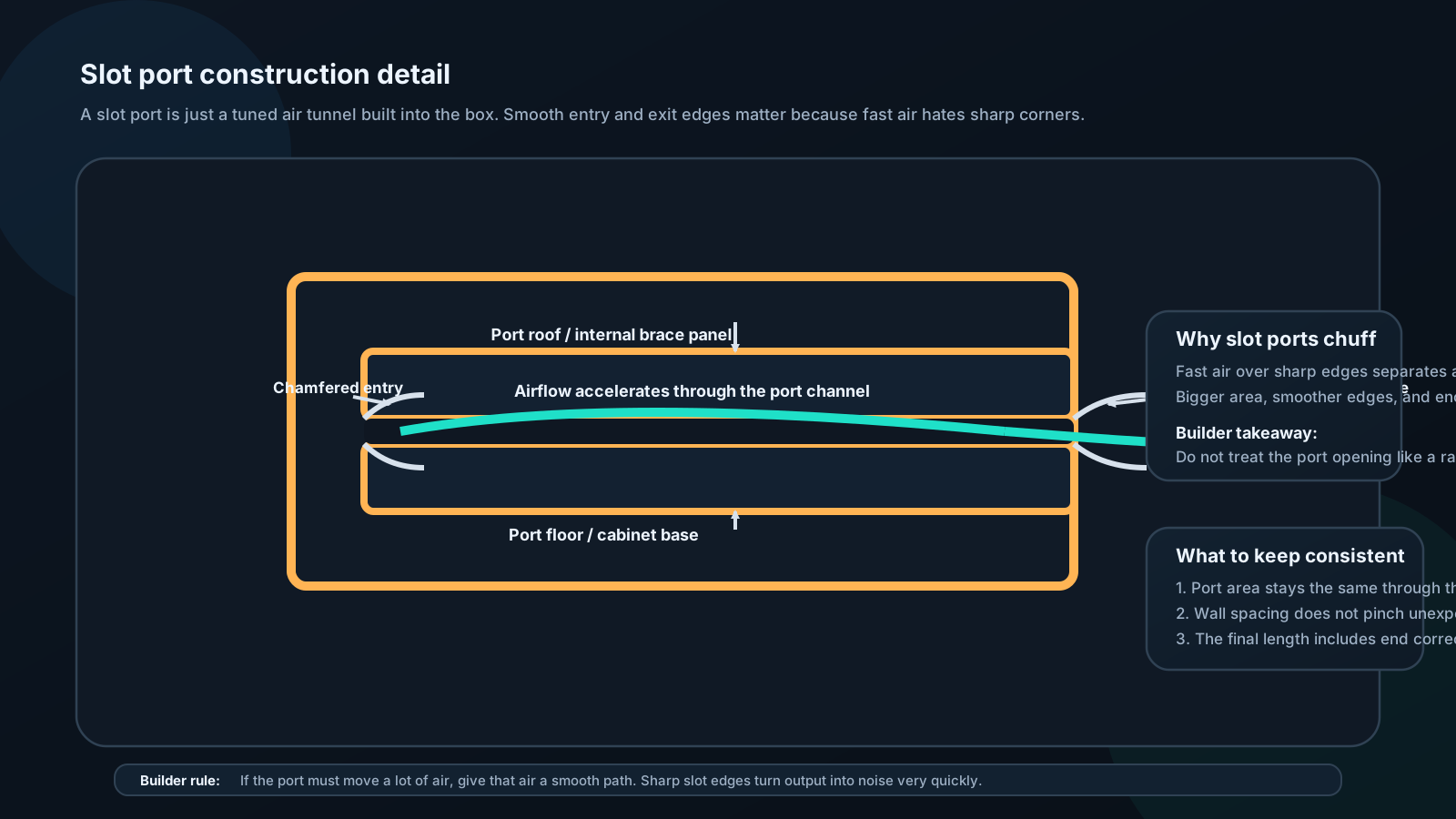
Round ports are easy to model, easy to buy, and easy to cut to length. Slot ports can fit the enclosure shape better and offer more area, but they take up more internal volume and require more careful layout.
- Use a round port when you want straightforward math and off-the-shelf parts.
- Use a slot port when the enclosure shape makes a tube awkward or when you need more cross-sectional area than a single tube can provide.
- Use flares or generous entry/exit radii whenever possible. Smoother ends reduce turbulence and audible chuffing.
Practical Port-Area Guidance
There is no single magic port-area number that fits every woofer and every power level, but there is a simple practical rule:
- More area lowers port air speed and usually lowers noise.
- More area also increases the required port length for the same box volume and tuning.
- If the required length becomes absurd, the answer is not hand-waving. The answer is to revisit the box volume, tuning target, or port layout.
For daily-driver ported builds, many designers aim to keep peak port velocity comfortably below the rough 30 m/s danger zone. Software such as WinISD, BassBox Pro, Hornresp, or a trusted calculator makes that check much easier than doing it by hand every time.
Corrected Worked Example
Use the same example as the math-reference page so the site stays internally consistent:
- Net box volume: 2.0 ft3 = 56.6 L = 0.0566 m3
- Target tuning: 35 Hz
- Port: 4-inch round port
The 4-inch round port area is:
A = pi * r^2 = pi * 2^2 = 12.57 in^2 = 81 cm^2 = 0.00811 m^2
Using the Helmholtz relationship in SI units gives an effective port length of about 0.348 m, or 13.7 inches. Subtracting typical end corrections for a simple round port gives a physical length of about 8.5 inches.
L_eff = 13.7 in
L_physical = 13.7 - 2.59 - 2.59
L_physical = 8.5 in
That means the earlier version of this page was wrong in three ways:
- it mixed square inches and square centimeters on the same example,
- it contained arithmetic errors, and
- it claimed that increasing port area makes the port shorter, which is backwards for a fixed box volume and tuning target.
The Tradeoff That Actually Matters
If you keep the box volume and tuning frequency fixed:
- a larger port area usually means a longer port,
- a smaller port area usually means a shorter port, but higher air speed,
- a larger box can make low tuning more practical, and
- a higher tuning target can reduce the required length.
That is why a design can be mathematically tuned yet still be a bad installer choice. The port may fit the formula but fail the real enclosure.
When to Change the Design
If the port you need will not fit cleanly, choose one of these moves instead of forcing the build:
- Increase the net box volume if the driver alignment allows it.
- Raise tuning a little if the low-frequency target is overly aggressive for the available space.
- Change from a single round tube to a properly laid-out slot port.
- Use software to confirm air speed, end correction assumptions, and the effect of bends or folds.
Common Installer Mistakes
- Forgetting that the port itself consumes internal volume.
- Using outside box dimensions instead of net internal volume.
- Ignoring flares, bends, and end corrections.
- Choosing a huge port area without checking whether the resulting length is still buildable.
Bottom Line
A good port is not the biggest port you can draw. It is the port that keeps air speed under control and still fits the enclosure as a real object. Use the 2.0 ft3, 35 Hz, 4-inch example as the sanity check: roughly 8.5 inches physical length is the trustworthy starting point for that alignment, not a 60-inch fantasy tube.