10.2 Advanced Sealed Enclosure Design
🔰 BEGINNER LEVEL: Getting Sealed Right
Why Sealed Sounds Different
Sealed enclosures have a reputation: accurate, punchy, controlled — but not as loud as ported. Understanding why helps you choose correctly and set realistic expectations.
The air spring effect:
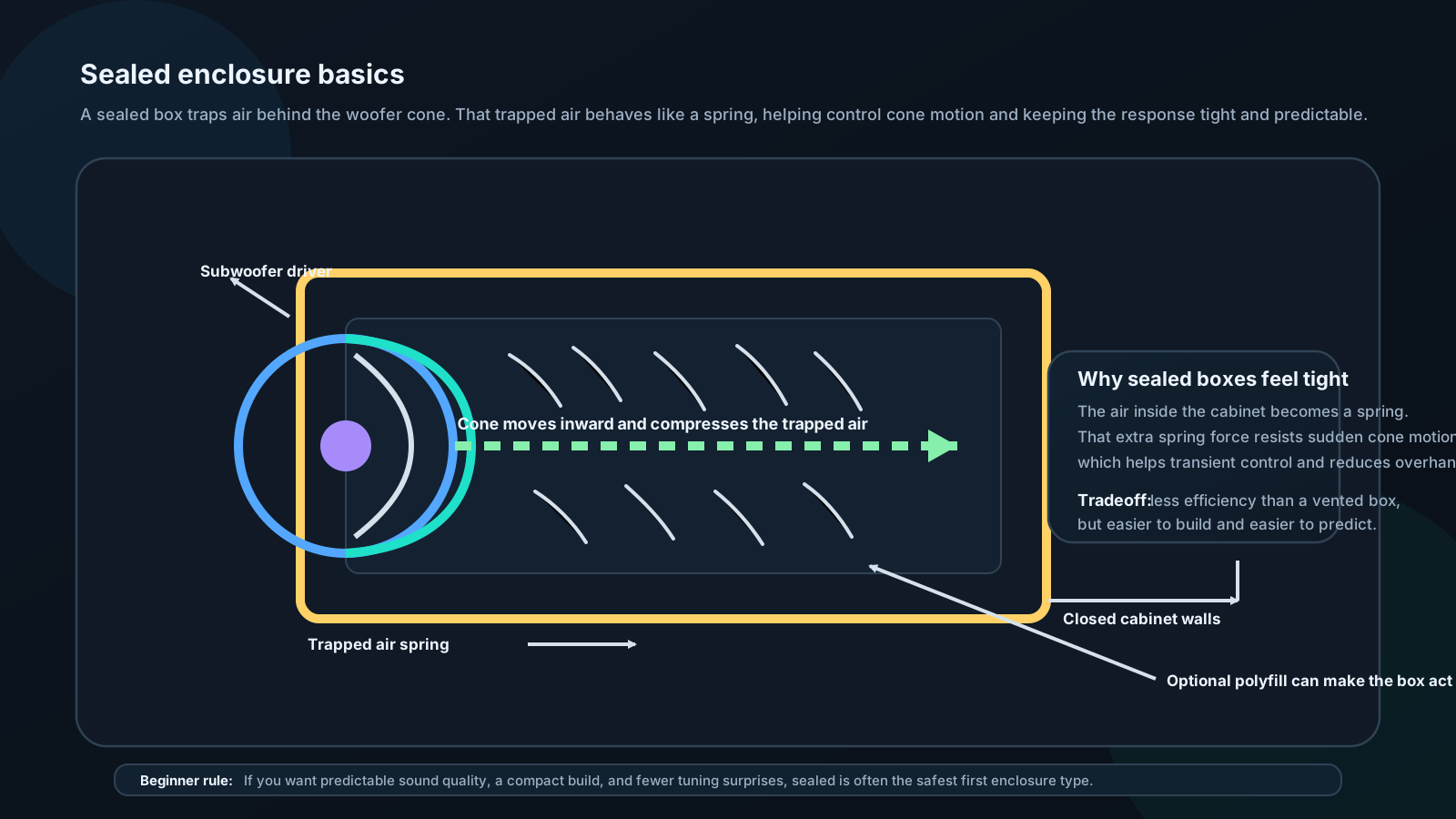
The air trapped inside a sealed box acts as a spring working against the driver's suspension. When the cone moves forward, it compresses the air inside, which pushes back. When the cone moves backward, it creates a partial vacuum, which pulls back. This additional restoring force stiffens the total suspension system.
What this does to performance:
- Raises the effective resonant frequency (Fc > Fs)
- Increases effective Q factor (Qtc > Qts)
- Creates a 12 dB/octave rolloff below Fc — gentle, predictable, safe
- Protects the driver from over-excursion at very low frequencies
- Does NOT help efficiency — sealed boxes are typically 3–6 dB less efficient than ported at the same frequency
Volume determines character:
A very small sealed box creates high Qtc (>1.0) — the response peaks before rolling off, creating that "boom box" one-note bass many people actually like. A large box creates Qtc near 0.5 — extended, flat, dry, audiophile.
For most music-oriented builds, target Qtc between 0.7 and 0.85. This gives a slight warmth (gentle lift above the rolloff) without excessive bloom.
Polyfill: Real Effect or Myth?
Polyfill (polyester fiber stuffing, the same material used in pillows) inside a sealed enclosure is real and beneficial — when used correctly.
What it does:
Acoustic wave energy hitting the polyfill is absorbed rather than reflecting back through the cone. This reduces standing waves and coloration inside the box. More importantly, it slows the effective speed of sound inside the enclosure, making the trapped air behave as if it has a higher compliance (softer spring). The box appears acoustically larger than it physically is.
How much to use:
0.5 lb per cubic foot is a good starting point. Loosely filled — not tightly packed. Packing it tight causes excessive damping of the driver's motion, which worsens performance.
Maximum effective increase: About 15–20% of box volume. A 1.0 ft³ sealed box with proper polyfill behaves like roughly 1.15–1.20 ft³. Useful for fine-tuning Qtc when your box came out slightly too small.
🔧 INSTALLER LEVEL: Alignment Design
Butterworth, Chebyshev, and Bessel — Choosing Your Sound
Each alignment represents a different compromise between bass extension, output, and transient accuracy:
Butterworth (Qtc = 0.707) — The Flat Standard
Maximum flat frequency response before the rolloff. No peak, no extra boost. If you play the widest variety of music and want the most accurate reproduction, Butterworth is the reference.
Box volume:
Vb = Vas × [(Qts/0.577)² − 1]⁻¹
The Fc is at the −3 dB point. Below Fc, response falls at 12 dB/octave, well-controlled.
Chebyshev (Qtc = 0.90–1.10) — The Warm Sound
A small response peak (1–3 dB) occurs before the rolloff. This peak adds warmth and apparent weight to bass instruments. The −3 dB point is lower than Butterworth in the same box size — apparent bass extension improves.
Trade-off: Slight group delay peak at resonance, mildly less accurate transient response. In most music listening this is inaudible or even preferred. Many dedicated car audio subwoofers are designed with Chebyshev alignment in mind.
Bessel (Qtc ≈ 0.577) — The Accurate Sound
Maximizes impulse response fidelity — group delay is as flat as possible. Bass sounds tight, dry, extremely accurate. No overhang, no bloom.
Trade-off: Requires a larger box for the same driver, and Fc is higher than Butterworth in the same box. Bass extension is sacrificed for timing accuracy. Rare in car audio but used in professional monitoring applications and reference systems.
Practical comparison for the same 12" driver (Fs=35Hz, Qts=0.55, Vas=50L):
| Alignment | Qtc | Box Volume | Fc (-3dB) | Character |
|---|---|---|---|---|
| Bessel | 0.577 | 80L / 2.8 ft³ | 52 Hz | Tight, accurate |
| Butterworth | 0.707 | 30L / 1.1 ft³ | 45 Hz | Flat, reference |
| Chebyshev | 1.00 | 9L / 0.3 ft³ | 38 Hz | Warm, impactful |
The Chebyshev alignment achieves lower apparent extension in far less box volume — which explains why it's so popular in practical car audio installations.
Calculating Box Volume for Any Target Qtc
Vb = Vas / [(Qtc/Qts)² − 1]
Example: Driver with Qts = 0.55, Vas = 50L, target Qtc = 0.85:
Vb = 50 / [(0.85/0.55)² − 1]
= 50 / [(1.545)² − 1]
= 50 / [2.387 − 1]
= 50 / 1.387
= 36.1 L = 1.28 ft³
System resonance Fc:
Fc = Fs × (Qtc/Qts) = 35 × (0.85/0.55) = 35 × 1.545 = 54.1 Hz
This system rolls off at −3 dB near 54 Hz with a very gentle 1 dB of warmth — a good general-purpose music build.
⚙️ ENGINEER LEVEL: Transfer Functions and System Modeling
Closed-Box Transfer Function
The low-frequency response of a sealed system is a second-order high-pass function:
H(s) = s² / (s² + (ωc/Qtc)×s + ωc²)
Where ωc = 2πFc
Magnitude response:
|H(jω)| = (ω/ωc)² / √[(1 − (ω/ωc)²)² + (ω/(ωc×Qtc))²]
Group delay:
τg(ω) = [2ω/ωc² × (1 − (ω/ωc)²) + (ω/ωc)³/Qtc] / [(1 − (ω/ωc)²)² + (ω/(ωc×Qtc))²]
Peak group delay at Fc for Butterworth (Qtc=0.707):
τg_peak = √2 / ωc = √2 / (2πFc)
At Fc = 50 Hz: τg_peak = 4.5 ms — well within inaudibility threshold at bass frequencies.
Power compression modeling:
Voice coil temperature rise:
ΔT = P_input × Re / (thermal_resistance × Rvc_cold)
Resistance rise:
R_hot = R_cold × (1 + α × ΔT)
Where α = 0.00393 /°C for copper
Power compression:
PC_dB = 20 × log₁₀(√(R_cold/R_hot))
At 200°C voice coil temperature (sustained heavy use):
R_hot = R_cold × (1 + 0.00393 × 200) = R_cold × 1.786
PC = 20 × log₁₀(√(1/1.786)) = 20 × log₁₀(0.748) = −2.5 dB
A driver that measured 105 dB at startup may only produce 102.5 dB after thermal equilibrium — significant in competition where every dB matters.
Complete Build Example — 12" Sealed Subwoofer for Daily Driver
Let's walk through a complete real-world build from driver selection to finished enclosure. This is the kind of build you'd do for a daily-driven sedan with moderate power and quality music playback as the goal.
The requirements: - Vehicle: Honda Accord sedan, trunk space available - Budget: $400 total (driver + amplifier + materials) - Music taste: Rock, jazz, acoustic — wants accurate bass, not boom - Power available: 500W RMS amplifier already owned - Space constraint: Maximum 1.5 cubic feet
Step 1: Driver selection
We need a driver with: - Qts in the 0.5–0.7 range (works well sealed) - Vas that allows 1.5 ft³ or smaller for Butterworth alignment - Power handling 500W+ - Reasonable sensitivity (88+ dB)
Example driver: Dayton Audio RSS315HF-4 (Generic example — verify current specs) - Fs: 28 Hz - Qts: 0.51 - Vas: 3.54 ft³ (100 L) - Xmax: 18 mm - Sensitivity: 87.3 dB - Power: 600W RMS - Price: ~$140
Step 2: Calculate optimal box volume
Target Qtc = 0.707 (Butterworth):
Vb = Vas / [(Qtc/Qts)² − 1]
= 3.54 / [(0.707/0.51)² − 1]
= 3.54 / [(1.386)² − 1]
= 3.54 / [1.921 − 1]
= 3.54 / 0.921
= 3.85 ft³
That's too large for our 1.5 ft³ constraint. Let's see what Qtc we get with 1.5 ft³:
Qtc = Qts × √(Vas/Vb + 1)
= 0.51 × √(3.54/1.5 + 1)
= 0.51 × √(2.36 + 1)
= 0.51 × √3.36
= 0.51 × 1.83
= 0.93
Qtc of 0.93 is a mild Chebyshev alignment — slight warmth, good for rock music. Acceptable. We'll use 1.5 ft³.
Step 3: Calculate system response
System resonance:
Fc = Fs × (Qtc/Qts) = 28 × (0.93/0.51) = 28 × 1.82 = 51 Hz
F3 (−3 dB point) for Qtc = 0.93:
F3 ≈ Fc × 0.9 = 51 × 0.9 = 46 Hz
This system plays flat to 46 Hz, then rolls off at 12 dB/octave. Perfect for music — everything down to the low E on a bass guitar (41 Hz) is reproduced well.
Step 4: Box dimensions
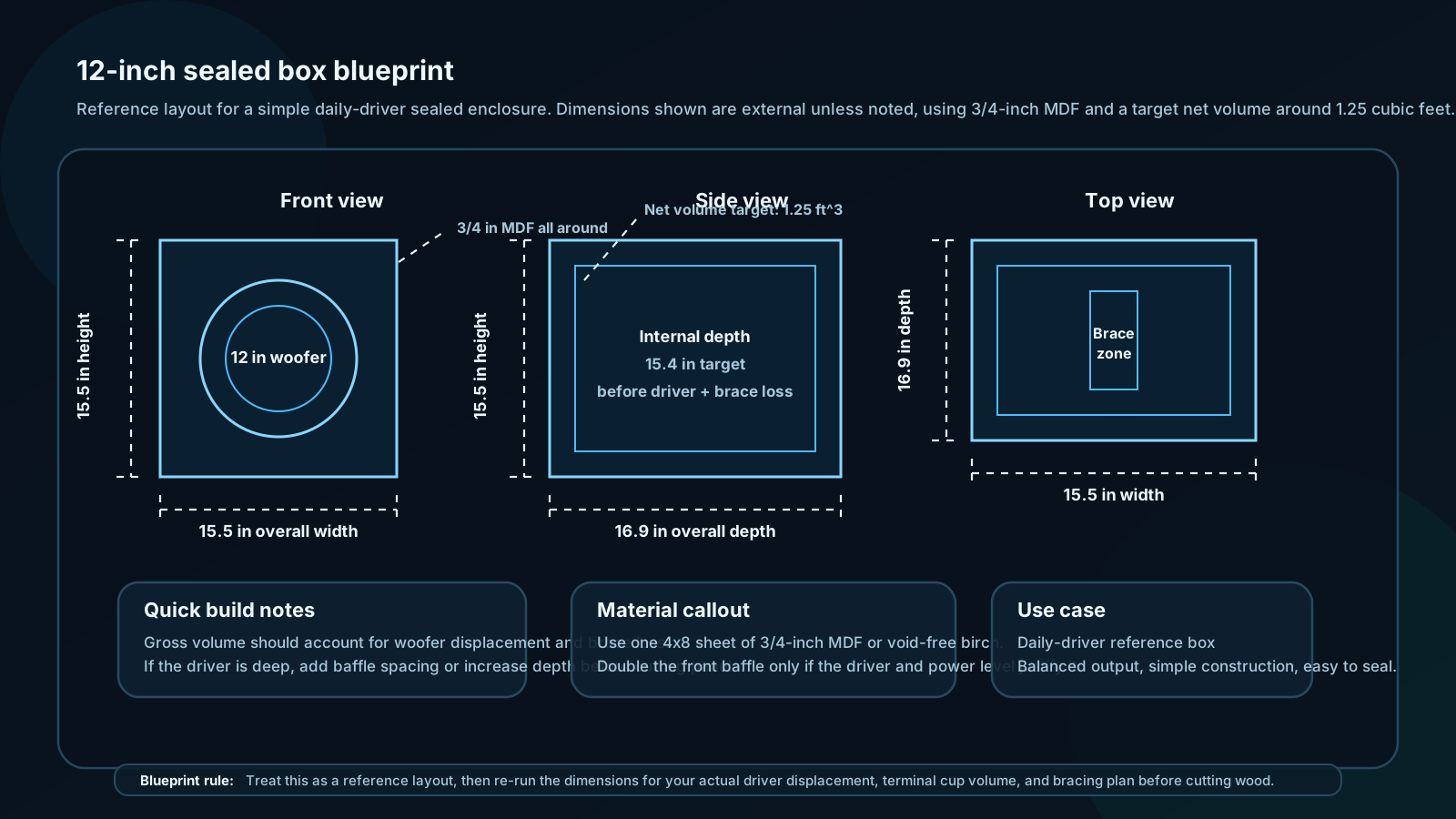
Net volume needed: 1.5 ft³ = 2,592 cubic inches
Driver displacement (12" woofer, typical): 0.15 ft³ Bracing volume loss: ~0.10 ft³ Gross volume needed: 1.5 + 0.15 + 0.10 = 1.75 ft³ = 3,024 in³
Target internal dimensions for compact build: - Width: 14" (fits between wheel wells) - Height: 14" - Depth: Calculate from volume
Depth = Volume / (W × H) = 3024 / (14 × 14) = 15.4"
Add panel thickness (3/4" MDF on each side): - External: 15.5" W × 15.5" H × 16.9" D
Step 5: Materials list
| Item | Quantity | Cost |
|---|---|---|
| 3/4" MDF (4×8 sheet) | 1 | $45 |
| PL Premium adhesive | 1 tube | $8 |
| Wood screws (1.5" coarse) | 1 box | $6 |
| Speaker terminal cup | 1 | $8 |
| 12 AWG speaker wire | 10 feet | $5 |
| Carpet or vinyl wrap | 3 yards | $25 |
| 3M 90 spray adhesive | 1 can | $12 |
| Polyfill (1 lb bag) | 1 | $10 |
| Weatherstrip foam tape | 1 roll | $6 |
| Subtotal | $125 | |
| Driver | $140 | |
| TOTAL | $265 |
Remaining budget: $135 for wiring and amplifier installation materials.
Step 6: Cut list (from one 4×8 sheet)
| Panel | Dimensions | Quantity |
|---|---|---|
| Top/Bottom | 15.5" × 16.9" | 2 |
| Left/Right sides | 14" × 15.5" | 2 |
| Front baffle | 15.5" × 15.5" | 1 |
| Back panel | 15.5" × 15.5" | 1 |
| Cross braces | 2" × 13" | 3 |
All panels cut from one sheet with material to spare.
Step 7: Assembly sequence
Day 1 — Cutting and dry fit: 1. Cut all panels to size on table saw 2. Mark driver cutout center on front baffle (11.125" diameter for this driver) 3. Cut driver opening with router and circle jig 4. Dry-fit all panels without adhesive — verify square 5. Drill pilot holes for screws every 5 inches along all edges
Day 2 — Glue-up: 1. Apply PL Premium to all edges of bottom panel 2. Attach front, back, left, right panels 3. Screw in place (predrill prevents splitting) 4. Apply adhesive to top edges 5. Place top panel, screw down 6. Wipe excess adhesive from inside with damp rag 7. Let cure 24 hours
Day 3 — Sealing and bracing: 1. Run bead of silicone caulk along all interior seams 2. Install cross braces with adhesive and screws (one across width at mid-depth, one diagonally) 3. Drill hole for terminal cup on back panel 4. Install terminal cup with silicone sealant 5. Let cure 24 hours
Day 4 — Finishing: 1. Lightly sand all exterior edges smooth 2. Fill any gaps with wood filler 3. Spray exterior surfaces with 3M 90 adhesive 4. Wrap with carpet, stretch tight around corners 5. Fold edges inside, glue down with contact cement 6. Cut driver opening carefully with razor blade
Day 5 — Driver installation: 1. Add 0.75 lb polyfill (loosely distributed inside) 2. Apply weatherstrip foam tape around driver cutout 3. Connect speaker wire to terminal cup 4. Mount driver with included screws (torque evenly in star pattern) 5. Leak test with incense stick — verify all seams sealed
Step 8: Amplifier settings
Subsonic filter: 25 Hz, 24 dB/oct (5 Hz below driver Fs) Low-pass filter: 80 Hz, 24 dB/oct (or 12 dB/oct if blending with full-range speakers) Gain: Set using DMM method (Chapter 4.4) targeting √(500 × 4) = 44.7V Bass boost: 0 dB (flat — driver alignment already provides warmth)
Expected performance:
In-car SPL at 50 Hz with 500W: approximately 108–112 dB Extension: −3 dB at 46 Hz, usable output to 35 Hz Character: Warm, musical, accurate — excellent for rock and jazz
This is a complete, proven, real-world sealed build that costs under $300 in materials and delivers excellent daily-driver performance.