10.4 Bandpass and Specialty Enclosures
🔰 BEGINNER LEVEL: When to Use Specialty Enclosures
Fourth-Order Bandpass
A bandpass box hides the woofer between two chambers. The back chamber is sealed. The front chamber has a vent. In the box's working bass range, most of the sound you hear comes from that front chamber and vent, not from the cone directly. In technical terms, that front side becomes the main acoustic radiator, which just means it is the part of the system doing most of the audible work in that range.
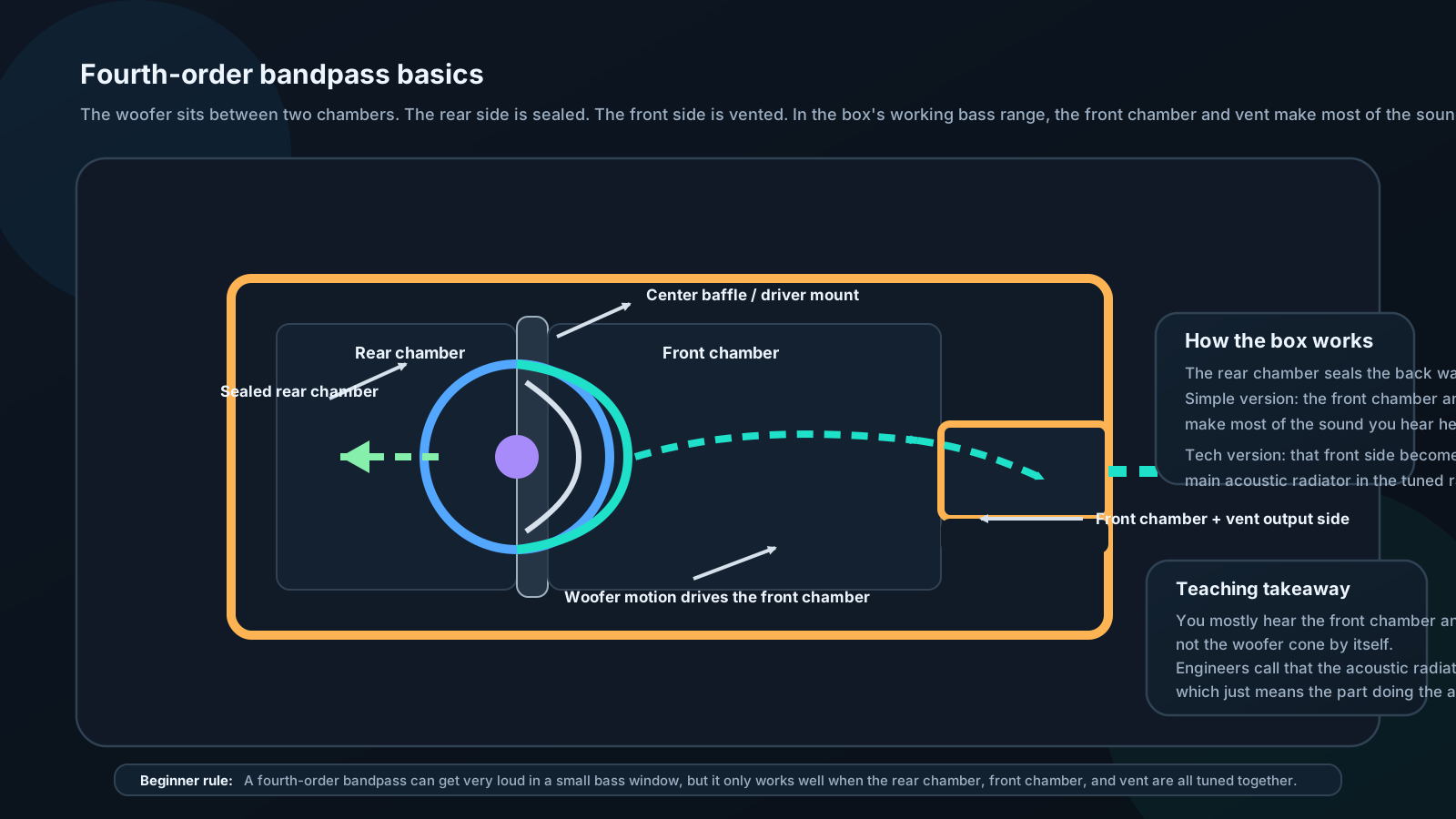
Why bandpass is used:
- Maximum efficiency in a narrow frequency range (competition uses)
- 6–12 dB more output than sealed at the tuning frequency
- Built-in bandpass filter — no crossover needed at the peak frequency
Why bandpass is not used for music:
- Very narrow bandwidth — plays well at one frequency, poorly at others
- No output below port tuning — subsonic protection is built in, but bass extension is limited
- Complex to design and measure — small errors in chamber ratio or port tuning produce poor results
- Group delay is high — less transient accuracy than sealed
For daily music listening: avoid bandpass. For demo systems that play one impressive test track at shows, or for SPL competition: bandpass is the tool.
Isobaric (Push-Push) Enclosures
Two identical drivers share the same acoustic load. The result: same output as a single driver in a box half the size.
When to use: You have extremely limited space (under-seat, narrow trunk) but still want real subwoofer performance. Two 8" drivers isobarically loaded in 0.3 ft³ can out-perform a single 8" in 0.3 ft³.
When not to use: You have adequate space. Isobaric requires two drivers for the output of one — double the cost, equal performance to simply choosing a driver that works in a larger box.
🔧 INSTALLER LEVEL: Design and Tuning
Bandpass Enclosure Design — Chamber Ratios
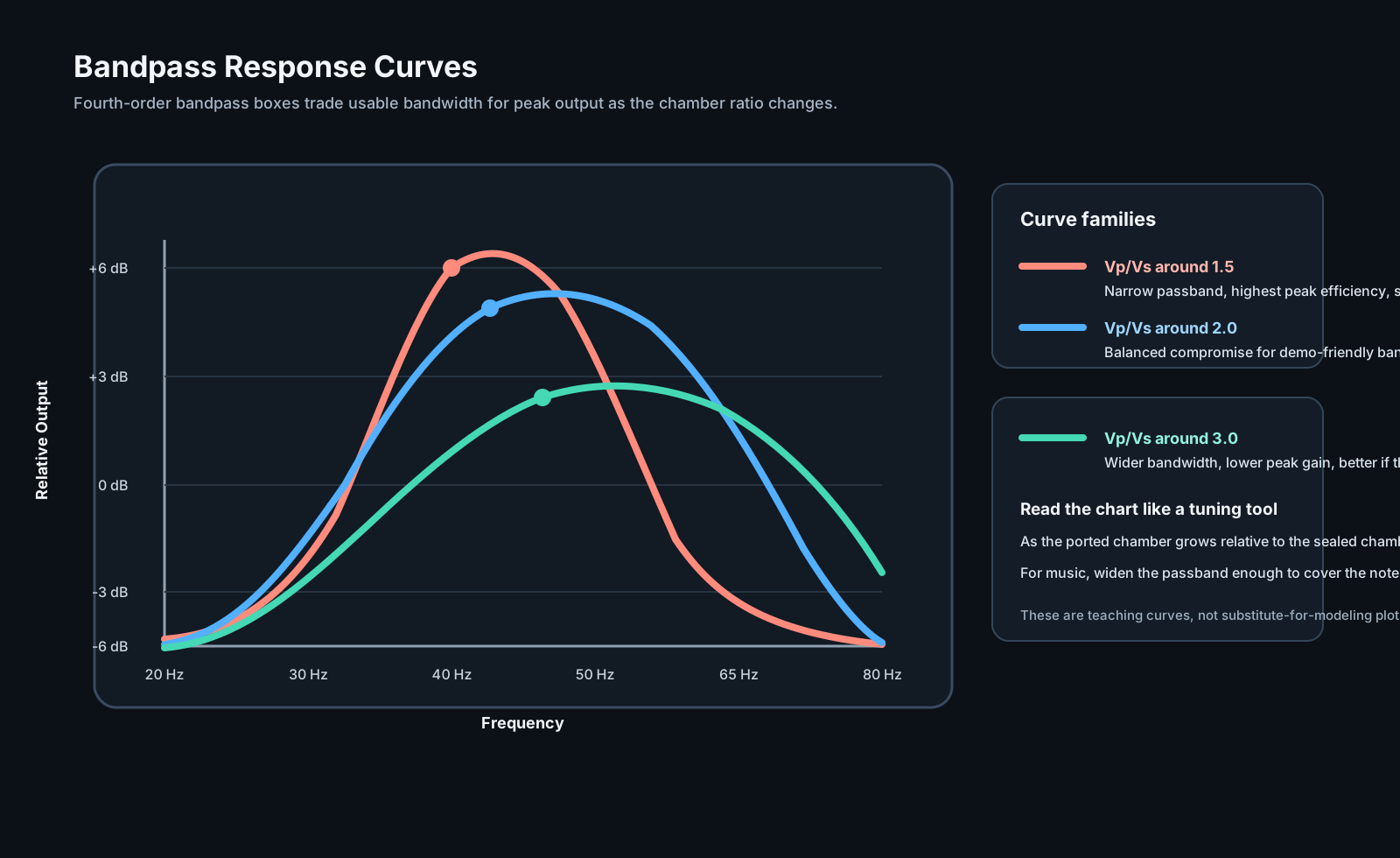
For a 4th-order bandpass (one sealed, one ported chamber):
Step 1: Sealed chamber volume
Vs = 0.7 × Vas
The sealed chamber controls the upper -3 dB point. Smaller Vs = higher upper cutoff. Larger Vs = lower upper cutoff, more output.
Step 2: Ported chamber volume
Vp = 1.5 to 3.0 × Vs
Larger Vp / Vs ratio = wider bandwidth but less peak efficiency.
Step 3: Port tuning
Tune port to the desired center frequency of the passband:
Fb = target_frequency ± 5 Hz
Calculate port length using the Helmholtz formula with Vp and target Fb.
Step 4: Verify bandwidth
Approximate passband (−3 dB points):
f_lower ≈ Fb × 0.7
f_upper ≈ Fc_sealed × 1.4
Where Fc_sealed is the sealed chamber resonance.
Adjust chamber ratio iteratively (or use WinISD's bandpass design mode) until bandwidth covers desired range.
Isobaric Design
The isobaric pair behaves as a single driver with:
Fs_iso = Fs × √2
Vas_iso = Vas / 2
Qts_iso = Qts (unchanged)
Wiring:
For push-push (both cones moving in same direction simultaneously): - Both drivers receive the same signal - Both voice coils must be wired in same polarity (both positive to same terminal) - Outer driver: positive terminal to amp positive - Inner driver: positive terminal to amp positive (reversed physical orientation means same acoustic polarity)
Physical arrangement:
Face-to-face: Magnet-out on both. Inner faces of cones touching or near-touching. Sealed air pocket between them = isobaric volume. Mount outer driver in enclosure baffle.
Magnet-to-magnet: Cones both facing outward. Sealed pocket at back. Less popular (larger depth required).
Enclosure calculation:
Use Vs_iso = 0.5 × Vas for sealed alignment. Calculate as normal sealed box using modified parameters.
⚙️ ENGINEER LEVEL: Transmission Line and Passive Radiator Theory
Transmission Line Enclosures
A transmission line enclosure is a tapered acoustic tube, approximately quarter-wave length at the driver's resonance, stuffed with acoustic damping material. At the driver's resonance frequency, the tube presents a specific acoustic impedance that loads the driver, controlling resonance and extending bass response.
Quarter-wave length:
L = c / (4 × Fs)
At Fs = 35 Hz, c = 343 m/s:
L = 343 / (4 × 35) = 2.45 m (8 feet)
Practical transmission lines use 30–50% velocity of sound loading from stuffing material, reducing effective length:
L_physical ≈ L_acoustic × 0.7 = 1.7 m
Still extremely long — impractical for most car audio. Used occasionally in high-end home audio (PMC, Linn) but essentially absent from car installations.
Passive Radiator — Mechanical Analysis
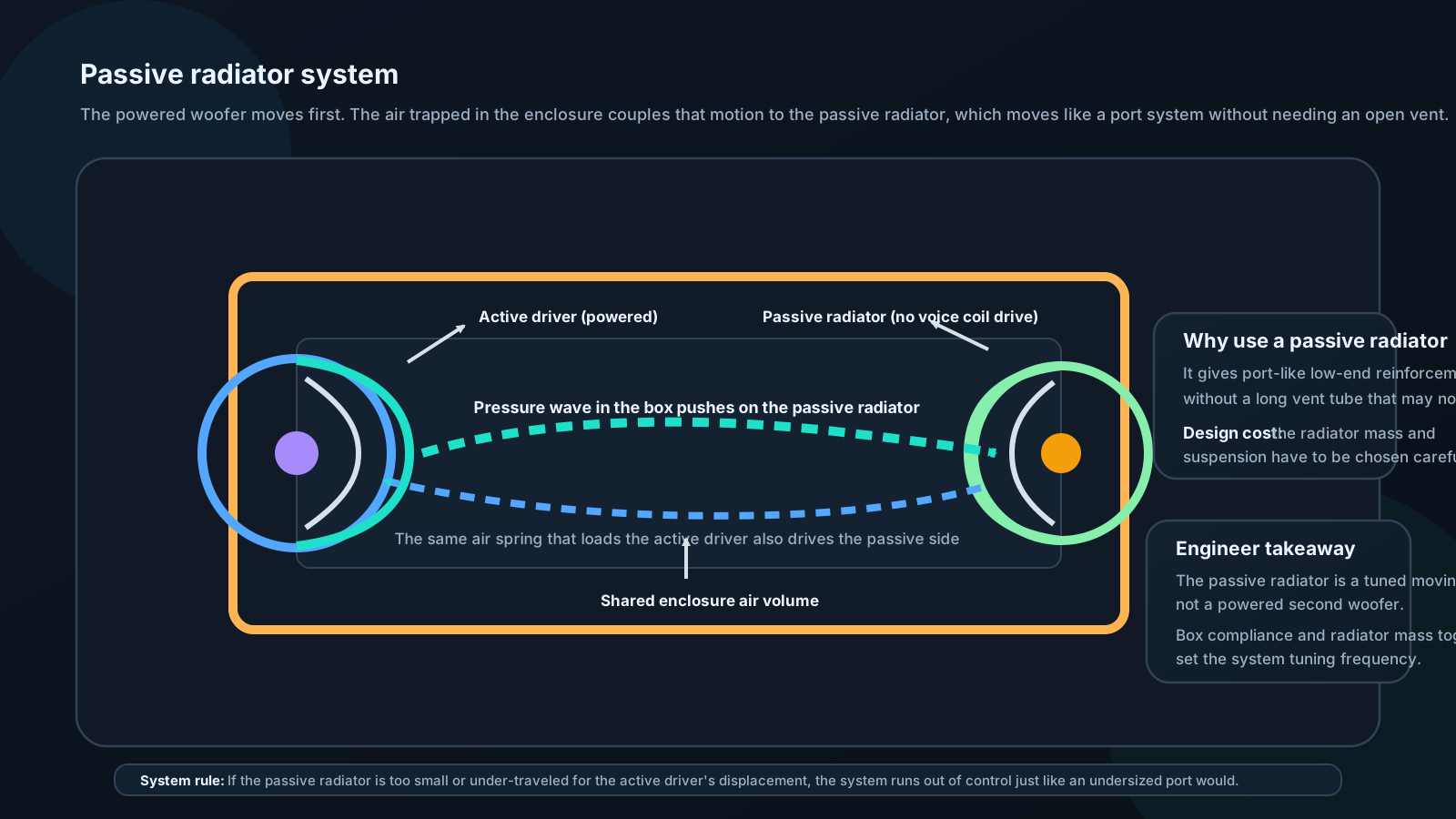
The passive radiator (PR) acts as a mechanically resonant mass-spring system:
PR free resonance:
Fpr = (1/2π) × √(Kpr / Mpr)
Where: - Kpr = suspension stiffness (N/m) = 1/Cpr - Mpr = total moving mass including added weights
Tuning the system:
The box + PR system resonance (equivalent to Fb in ported):
Fb_pr = (1/2π) × √[(Kpr + K_box) / Mpr]
Where K_box = ρ₀c²Sd²/Vb (air compliance stiffness of box)
For practical tuning, add mass to the PR cone (bolts, lead weights, putty) and measure system resonance via the impedance curve's double-peak location, just as you would verify port tuning in a ported box.
PR sizing requirements:
Sd_pr ≥ Sd_active     (same area or larger)
Xmax_pr ≥ Xmax_active × Sd_active/Sd_pr   (sufficient stroke)
The PR must handle the same volumetric displacement as the active driver — if it's the same size, same Xmax required. If it's larger, stroke requirement reduces proportionally.